

Take a trip back in time to the 1950s. If you were to look out your window on a Saturday afternoon, you might see a couple walking down the sidewalk, a teenager walking his dog, or a young mother pushing her child in a stroller. But it’s unlikely that you would have seen a runner zip by.
Until about the 1960s, the sport of running took place almost exclusively on the track, and most runners were men. Today, you’re more likely to see runners on trails and sidewalks than on a track, and it seems that more women are running than men. Whether that’s because women tend to be more health-conscious or are more focused on their physiques, the sport is running in a new direction—off the track, propelled by the feet of women.
In Peoria, the sport has advanced significantly through the efforts of the Illinois Valley Striders—IVS or Striders for short—an organization committed to enhancing both the running environment in the region and the community as a whole. To get the lowdown on Peoria’s running community, I sat down with the group’s founder and former president, Steve Shostrom, and current president, Jim McIntyre. As the saying goes, Striders “run this town.”
The Striders Rise
In the early 1970s, Peoria hosted its share of running events. The massive amounts of time and effort required to put these events together was one of the reasons that Dave Schneider, an employee of the Peoria Park District, thought the River City needed a running group. Schneider knew some runners who he thought might be interested in putting that group together, and called a meeting to discuss the idea. Just two people showed up—Steve Shostrom and Ed McGraw—but the wheels were set in motion, and several months later, the Illinois Valley Striders had about a dozen members.
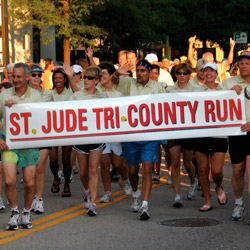
St. Jude Memphis to Peoria Run
Taking advantage of the running craze, Gene Pratt and Mike McCoy started the Memphis to Peoria Run in 1982 as a way to raise money for their beloved charity, St. Jude Children’s Research Hospital. The original concept had runners doing laps around Landmark, which didn’t raise much money and wasn’t too fun either. The second idea was to raise money by charging runners to run from Peoria to Memphis and back again. After realizing that that would be nearly 1,000 miles, Pratt and McCoy decided they’d settle for driving to Memphis and running the 465 miles back.
So Pratt and McCoy placed an ad in the paper and ended up with 21 runners, themselves included. They drove to Memphis and ran home relay-style, each person running between 40 and 60 miles in three days. Those 21 runners raised $22,500 that first year. “That was a lot of money back then!” exclaimed McCoy. Since then, the concept of the run has remained the same, only the number of participants and the amount of money raised have changed. Today, runners raise an average of $4,500 each. A total of $2.2 million was raised in 2008, bringing the total benefiting St. Jude since 1982 to $17.9 million.
This year, 1,800 runners will leave Peoria on July 28th, spending the night in Memphis and touring the hospital the next morning. At noon, the runners will begin their journey back to Peoria, each team running for eight consecutive hours. They will return just in time for the St. Jude Telethon on August 1st.
Because some people can’t commit to the distance or time it takes to run from Memphis to Peoria, there are 20 auxiliary runs from cities like Chicago, Bloomington and St. Louis, to name a few. This allows more people to participate and help raise money for a great cause.
“We had the good luck of starting in the ‘70s,” explained Shostrom, “which went right along with the running boom.” The sport then grew exponentially in the ‘80s, and is currently experiencing yet another boom. Shostrom notes that the faltering economy may have something to do with that. When it becomes difficult to justify monthly gym memberships, putting on a pair of sneakers becomes a logical alternative. Sidewalks are free, you know!
Shostrom also credits the fitness drive with leading so many to the sport. “[Running] is something you have control over yourself,” he said. “If you decide one day that you want to lose X pounds…the easiest thing you can do is find a pair of shorts and go out and take a run, and slowly but surely get yourself in shape.” Unlike most team sports, running can be done right out of your back door, whenever you like, with or without others.
While many do run alone, most runners will tell you that they prefer to have a buddy. “Belonging to a group…is important because you feel a part of something—it quickly becomes a very important part of your social life,” said Kris Stash, who started running in 1989. “You are much more likely to go out and run on a rainy or cold day if you are meeting up with someone or are part of a race or group.” Belonging to a running group also presents opportunities to share experiences and challenge one another.
Finding Your Niche
“It’s hard to believe that we started in the ‘70s,” reflected Shostrom. “When I was president of the Striders, I literally knew everybody who ran in Peoria. [McIntyre] can’t claim that, but there’s also about a thousand times more runners now than there were then. So it’s pretty amazing.”
While most Striders are runners, the group also consists of quite a few walkers, as well as some who no longer run but still support the sport. According to Shostrom, many people join the Striders looking to lose weight. “I think you can say that the people who come into running that way get pretty loyal and want to give back.” And it’s these dedicated Striders who make the group’s efforts successful. They have never had paid staff members, relying instead on its core of top-notch volunteers to help with regional races and training programs.
With activity levels ranging from fitness walking to marathon completion, new Striders are sure to find their niche. McIntyre estimates that IVS has about 150 members in their advanced training program, which consists of hardcore runners who are “anywhere from sub-five-minute milers to 11-minute milers.” Another 500 Striders are dedicated to running consistently, and the rest do it for fitness, fun or relaxation. And yes, runners maintain that the sport really is relaxing.
“Running is my sanity,” Stash explained. “I can have a horrible day at the office or something really weighing on my mind and go out for a run and the problems don’t seem half as bad…The icing is that exercise is also very good for you and helps to keep your attitude young and body healthy.”
Making Great Strides
When it comes to running—and, one might say, life in general—there’s usually a goal and a desire to improve. To this end, the Illinois Valley Striders offer its members several programs to help them realize their goals.
Building Steam was started 16 years ago to prepare novice runners and fitness walkers for the annual Steamboat Classic. Always a popular program, about 100 volunteers guide 400 participants in improving their ability levels each year. “When we started Building Steam,” continued Shostrom, “the same people [were having so much fun that they] kept coming back, so all of a sudden there was a need for [a program for] the more experienced runners,” and thus, Team Steam was born. Aimed at more accomplished runners, the 14-year-old Team Steam draws about 200 participants each year.
More “Steam children,” as Shostrom calls the various training programs associated with the Steamboat Classic, have been added through the years, including Corporate Steam, a health and team-building program for local businesses; Uniform Steam, for those in the military or community services; Scouting Steam, for Boy and Girl Scouts and their parents and guardians; and Scholastic Steam, which brings track, cross country and other scholastic athletes together.
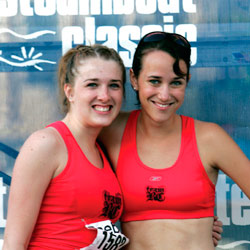
The Steamboat Classic began in 1974, one year after the formation of the Striders, and remains an internationally known running event. The four-mile race is known as the “world’s fastest four miles” because every world record for this event, in addition to more than 50 different countries’ national records, has been set at Steamboat. The 15K race is known as “Illinois Toughest 15K.” About 14 of the Olympians who ran in Beijing were Steamboat participants.
“Running is probably the greatest example of the growth of participant-type sports,” said Shostrom. “The event is important—not because there are some really fast people running 10 miles or something. What’s important is that there are 10,000 people running…and they’re all having a hell of a time. It becomes an event itself because of all of the folks who want to participate.” In Peoria, Shostrom said, the four largest running events are the Steamboat Classic, St. Jude Memphis to Peoria Run, Race for the Cure and the IHSA State Cross Country Meet, which has taken place in Peoria since the early ‘60s.
The Striders also offer kids an introduction to the sport in a non-competitive environment with their Kids’ Series. Held on Proctor Hospital’s quarter-mile path, children can run a quarter, half or full mile event, or all three, if so inclined.
Tracking Time
“Time is a valuable commodity to a runner,” noted Shostrom. “It’s an easy way to grade yourself.” And not only do runners rate their progress compared to their own times, but to the times of others as well. “So there’s always a lot of times banging around in [runners’] heads—your time, your friend’s time, the best time in the area,” he continued. Of course, there are also many runners who don’t care about time at all and run the distance purely for enjoyment.
Shostrom remembers a time before today’s sophisticated timing systems. “People would finish and not know what their time was. Some races would give you a program or somehow show you what your time was, and that was very important because a lot of races didn’t give a damn.” That’s why there was suddenly a market for timing systems and watches.
The Striders have always been “impeccable” about keeping track of and recording runners’ times at their races. This dedication made the 2005 Steamboat Classic the guinea pig for the testing of a new, sophisticated timing system. Philip Lockwood, a running enthusiast and IVS member, paired his knack for innovation with a love for running when he founded Mercury Sports Group with the goal of improving the way races are timed. The company now operates as IPICO Sports, of which Lockwood is vice president and chief technology officer, and is a leader in the sports timing industry.
The running community in Peoria has evolved considerably since the sport became widely popular in the 1970s, much of which can be attributed to the efforts of the Illinois Valley Striders. What started primarily as a group for active road racers has evolved into a community organization focused on fitness. Through its various events and training programs developed for people of all ages and ability levels, the Striders have positioned Peoria in a well-respected spot in the international running community. a&s
 Running Central
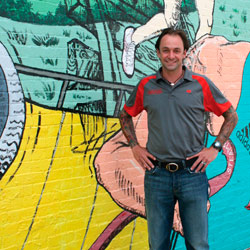
Aside from his contributions as a founding member of the Illinois Valley Striders, Steve Shostrom believes that opening Running Central was one of his greatest accomplishments. Years ago, while working as an attorney, Shostrom received many phone calls asking if there was a store in Peoria that sold special running shoes or how one could cure shin splints. As Peoria’s running community grew, these calls interrupted his work more frequently.
Shostrom thought that people deserved good answers to their questions. But instead of answering the same questions over and over, he decided to open a store that would serve as the center of running in Peoria—with all of the necessary footwear, clothing and gear, as well as information and applications for area races. “If you get involved in an enterprise that involves something you love, and you love to evangelize people so that they love what you love—what a platform!” For Shostrom, Running Central was exactly that platform.
In late 2007, about three decades after it opened, brothers Adam and Ian White took over Running Central. With a mission of “helping people improve their experience on this journey called life,” Adam said, the store has also become known for its exceptional customer service. No other store in the area has experienced staff willing to dedicate the time necessary to determining which shoe gives each individual the perfect fit. “It’s more than selling somebody a pair of shoes; it’s selling them the right pair of shoes,” White said.
Taking the store’s mission even further, Running Central teamed up with the RiverPlex in January and opened a second location in the club’s lobby. While historically the store focused on “serious” runners, Running Central now caters to novice runners and walkers as well, who happen to make up most of those using treadmills at health clubs.
“[Shostrom] and his comrades started a huge legacy three decades ago,” said White, “and it’s a privilege and honor for my brother and I to be carrying that torch now.”