
The son of a widely known Chinese painter, Vin Luong received an early introduction to art and technique from his father. He came to Peoria from Vietnam in 1987, destined to follow in his father’s footsteps.
A Father’s Inspiration
Vin’s father, Siu-Hong Luong, was born in Canton, China, where he attended art school before fleeing his homeland during World War II. After settling in Vietnam, he became an art professor and, over time, began to focus more on his own work. Recognized as one of the top artists in the country, he exhibited his work throughout South Vietnam.
Siu-Hong’s artistic style was called Lingnan, referring to the mix of traditional and modern elements by artists from the Guangdong province of China. According to lingnanart.com, this manner of painting began in the 19th century, attaining national visibility and becoming a distinctive style in the early part of the 20th century. The leaders of the Lingnan School of painting “combined the local style with elements of Western and Japanese realist painting to create an art that they hoped would be more accessible to the citizenry of China’s new republic than the literati painting of the past.”
Vin was born in Saigon in 1966. As a child, he was surrounded by art. He would sit at the table where his father was working and observe how he painted. It amazed him to watch his father lay out his brush strokes and, in a few minutes, turn those strokes into a tiger or a peacock. His mother had always been very supportive as well—she was married to a painter, after all—and Vin felt very fortunate to grow up with their encouragement.
Sadly, Siu-Hong Luong passed away when Vin was just nine years old, never knowing that his son had followed in his footsteps.
The Path of a Young Artist
When Vin was 14 and still in Vietnam, he walked past a Western art studio and decided to 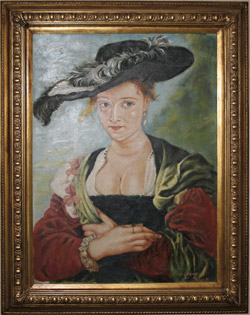 take classes from the owner. After that, he did lot of self-study, experimenting with a number of different painting styles and reading a great deal of books. From the Renaissance to Impressionism to abstract art, he was influenced by the masters, closely examining their strokes and style. The Renaissance Age—Michelangelo and da Vinci, in particular—were inspirations to Vin. He found the way Michelangelo could paint the human body fascinating.
At 15, Vin copied a portrait by Peter Paul Rubens, a prolific 17th century Flemish Baroque painter, which became one of his first oil paintings. When he started painting, all he knew was watercolor and rice paper from the traditional Chinese—oil was a whole new world. It took several months to paint the Rubens portrait, but he kept at it, and today the piece hangs in his studio as one of his favorites, a reminder of when he was young, still searching…still learning.
After studying the Renaissance, Vin moved into the revolutionary literary and artistic movement known as Surrealism. Developed in the early 1920s, Surrealism attempted to “express the workings of the subconscious and is characterized by fantastic imagery and incongruous juxtaposition of subject matter” (thefreedictionary.com). In his work today, you can see both the Renaissance and Surrealism styles, with a hint of the Chinese influence.
Vin’s oldest brother never made it to Vietnam with the rest of the family; instead, he relocated to the United States with the help of Catholic Social Services, who assisted refugees fleeing communism. Over time, the whole family was able to move to the U.S. to be with him.
Vin’s artistic career in Peoria began in 1987, when he landed his first job at Bibo Gallerie, painting portraits, framing pictures and doing commission work. The turning point for him came in 1995, when he felt that he had found his voice and identity and began to emerge with his own distinctive style. In 1998, he hosted his first solo show, and today, he is able to be self-employed as an artist.
Portals & Half-Apples
Vin starts his artistic process with a sketch. As he sketches, he thinks through the subject matter and concept, and often sees something that inspires him to paint. He usually sticks to using acrylics on canvas, but enjoys trying other mediums such as oil, drawing or ink. His paintings can take anywhere from several days to several months to complete.
He used to travel to shows quite often, but today, most of Vin’s customers are in the Peoria area. In the past few years, he took some time off from shows before re-emerging last November at Picture This Gallery in Peoria Heights for a show entitled Portals – Mixed Media by Vin Luong.
To illustrate the theme of portals, each of his works in the exhibit featured a window or door, symbolizing different paths throughout his life. “All of my life experience has been either looking in or looking out…or walking in or walking out,” explained Vin. “From that, I just like the idea of a portal—it doesn’t matter what image ends up on the other side.” 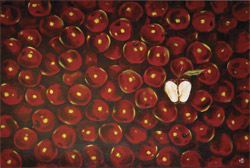
His other signature symbol is the half-apple. One day, he was eating an apple and cut it in half. After looking at its interior, he fell in love with the look. “You can see the seeds and the stem of the apple. The longer it sits out, the apple begins to change color, but you still always see the red around the edges. You see a lot more of the apple on the inside than on the outside,” he remarked.
Roots Run Deep
Vin’s roots in Peoria run deep. His mother, sister and one brother still live here—he also has a brother in Texas and one in Hong Kong. He met his wife, a musician, at Rhythm Kitchen one night several years ago when she was playing a gig with a local band. At one time, he had considered moving to New York City, but to Vin, it doesn’t matter where he lives—his life is what he makes of it. And Vin has learned to like Peoria. “
I don’t care if I don’t get rich or become a famous artist,” said Vin. “That’s the dream you always have, but as you grow older—as long as you can do what you love the most and make a living at it—for me that’s the best thing!
“I would still love to be able to travel around the world doing shows, [but] if not, and all I do is paint for a living and never get to go anywhere, I am still very happy…The life of an artist is that you don’t get really 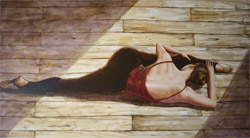 famous until after you die. Do it once and do it right." a&s